
Who or What Should Run Your Local Service Business’s Marketing?

Updated
Quick answer: A local marketing agency typically costs $1,500 to $5,000 a month, plus ad spend. An agency is the right call for a large, multi-location business with many markets and campaigns to manage. For an appointment-based service business with one location or a handful, an AI marketing tool covers the repeatable work (Google Business Profile, reviews, social posts and local ads) for far less.
What Does a Local Marketing Agency Actually Do?
A local marketing agency is a team you pay a recurring fee to run your marketing on your behalf. In practice, that usually breaks down into a handful of recurring deliverables: managing your Google Business Profile and local listings, building and running paid ad campaigns, writing and posting social content, monitoring and responding to reviews, and sending you a monthly report on what happened.
You're assigned an account manager as your point of contact, and depending on the agency's size, the actual work gets done by that same person or gets routed to a broader internal team you rarely speak with directly. Either way, the model is the same: you describe your business once, hand off the ongoing execution, and check in periodically to see how it's going.
The Real Cost of Hiring a Local Marketing Agency
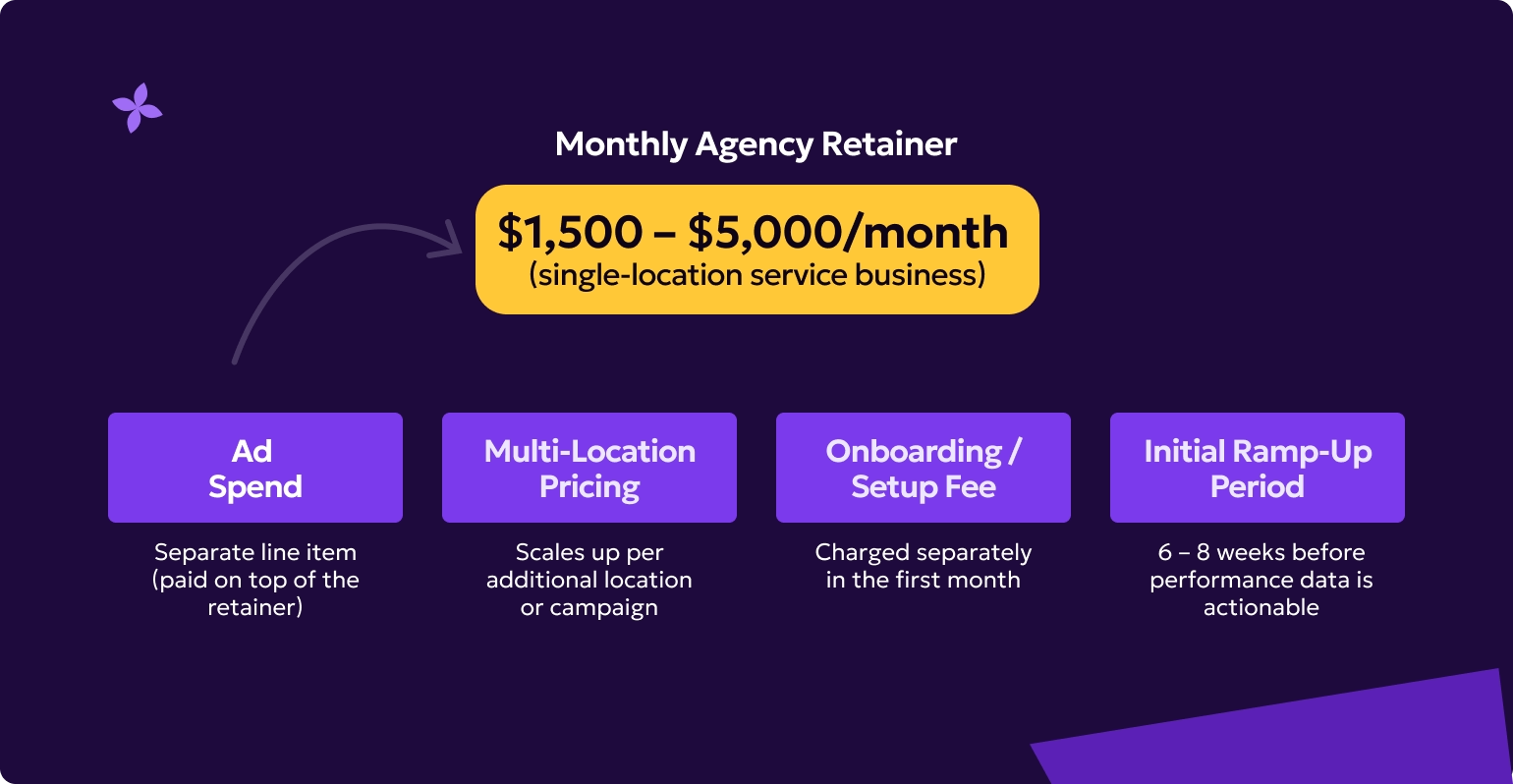
For a single-location service business, local agency retainers typically land somewhere between $1,500 and $5,000 a month — and that's before ad spend, which is a separate line item on top. Add a second or third location and that number moves up from there, since most agencies price per location or per campaign. Add a setup or onboarding fee in the first month, a contract term that usually runs three to twelve months, and a ramp-up period of six to eight weeks before there's enough data to tell whether any of it is working.
The retainer is also just the starting number. Extra revisions past what's included, adding a platform that wasn't in the original scope, or requesting custom creative work often comes with its own line item. It's a fixed-cost commitment you're making before you've seen a single result — a different bet than it sounds like at the proposal stage.
Agency vs. DIY vs. AI Tool: A Practical Comparison

Marketing Agency

DIY Tool

AI Marketing Tool
Where Agencies Genuinely Win
An agency is the right call in specific situations, and it's worth naming them plainly. If you're running marketing across a large, multi-location footprint — many markets and many competitive landscapes to track at once — that's the complexity an agency's account structure is built for. A single location or a handful of them is a different story; that's still well within reach for a tool built specifically for local service businesses.
The same scale logic applies to paid ads. Multiple campaigns running across platforms at once, budgets that need daily adjustment, promotions launching and ending on their own schedules — each one requiring its own setup, tracking, and audience list. That's active, ongoing account management, and it's exactly what a dedicated agency team is built for.
If you need heavy custom creative — a full brand video shoot, a rebrand, campaign photography — that's still a human production job. And if you want a dedicated strategist thinking specifically about your competitive position in your market, that's a level of bespoke attention an agency can offer that a self-serve tool isn't built to replace.
Where an AI Marketing Tool Wins for a Local Service Business
For a relationship-driven, appointment-based business — the kind where you want the same clients coming back every few weeks — marketing has one measurable outcome: filling the calendar, and keeping it full. That comes down to a fairly specific, repeatable set of tasks: a Google Business Profile kept current enough to show up correctly, and often, when someone searches; reviews that get answered so the next reader can see the business is paying attention; a social presence that ensures relationships don't go cold between appointments, and nudges the ones circling a decision to commit further; and local ad spend that keeps the business in front of people who are already close to booking — all covered in more depth in Local Service Business Marketing in the Age of AI.
That's also, almost exactly, the list of things a marketing agency bills you for every month. It's repetitive by design — the same tasks, running every month — and that kind of structured, recurring work is exactly where a tool built for this job earns its keep. AI tools that specialize in local marketing — designed around this exact workflow — have gotten genuinely good at running it: consistent, professional-grade output, for a fraction of an agency retainer.
Zylo is built that way. It runs that execution for you — always on, whether that's a Tuesday afternoon or a Sunday night — and specific to your business: your own voice, your own photos, your own offers. You stay in control of a system that runs itself, without adding a new piece of software to learn or a person to manage, with enough room built in to actually shape what it makes — adjust the offer, swap the photo, rewrite the line that doesn't sound right. (It usually already does.)
Local vs. National Agencies
Does the Difference Even Matter Anymore?
Less than the label suggests — but there's one real exception worth naming. Most agency work — ad management, content calendars, reporting — happens remotely today regardless of where the agency's office sits, so "local" doesn't automatically mean someone who knows your neighborhood any better than a national shop would.
The exception is cultural fluency: a local reference, a community event, the shorthand that makes an ad or a post land differently for people who actually live there. An agency that's genuinely dialed into your market can use that well, and it's a real edge when they do. That edge depends entirely on how invested that particular agency is in going that deep for you — plenty of agencies with a local address don't go much further than a national one would.
What matters more reliably, across both types, is whether the agency has real experience with appointment-based service businesses specifically — a team that mostly works with retail or e-commerce clients will bring the wrong playbook to a business that runs on booked calendars. Ask about both: how well they know your market, and how well they know your kind of business.
How to Decide: A Quick Self-Assessment
Everything above narrows down to one practical decision: agency or AI tool. (If you land on agency, the local-versus-national question above still applies — but this is the bigger call.) A few questions cut through most of it faster than a pros-and-cons list.
- Do you have more time or more budget to work with right now?
- Would you rather work through a person managing the account for you, or operate a tool that gives you control without the execution?
- Are you running a single location or a handful of them, or a larger multi-location footprint spanning many different markets?
- Does your business need heavy custom creative on a regular basis, or consistent standard content?
- Are you comfortable committing to a multi-month contract, or do you want to stay free to change course next month?
- Is your paid advertising complex — multiple platforms, frequent promotions, demanding creatives, daily budget changes — or fairly steady and standard
If your honest answers lean toward more budget than time, a large multi-location footprint, complex or frequently-changing ad campaigns, heavy custom creative, and a contract you're comfortable committing to, an agency is probably the right fit. If they lean toward operating the system yourself, one location or a handful of them, steady local ad spend, staying free of a contract, and standard content over custom production, the AI tool is probably the better one. If you want a more structured read on where your marketing actually stands before deciding either way, Zylo's local marketing maturity assessment walks through that in about five minutes.
FAQ
How much does a local marketing agency cost?
Most single-location service businesses pay somewhere between $1,500 and $5,000 a month in retainer fees, not including ad spend, setup fees, or a contract term that typically runs three to twelve months. That number moves up with each additional location.
Can I do local marketing myself without an agency?
Yes — a Google Business Profile, review responses, and a social presence are all things a business owner can run directly, especially with an AI tool handling the execution. The harder part is usually consistency: keeping it going once you get busy, month after month, which is exactly the gap AI marketing tools like Zylo are built to close.
What's the difference between a local and a national marketing agency for a small business?
Less than it used to be, since most of the actual work happens remotely either way — though a local agency that's genuinely invested in your market can bring a cultural fluency to the work that a national one won't have. Either way, the more useful question is whether the agency has real experience with appointment-based service businesses.