
Why Consistency Is the Foundation of Local Business Marketing


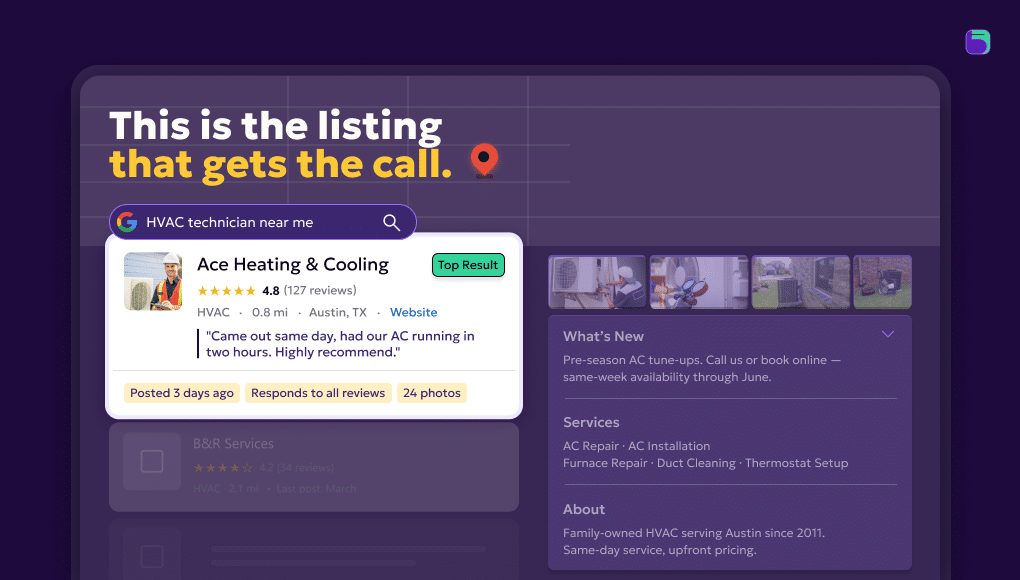
Someone in your neighborhood is searching for an HVAC technician tonight. It's July, their AC just quit, and they're on their phone pulling up Google Maps. Two businesses come up with solid reviews, covering the same zip code, doing the same work.
One has a post from this week, recent job photos, and three reviews with thoughtful responses. The other has a post from last March and two reviews sitting unanswered since winter.
The first technician gets the call.
Not because of their work or their pricing. Because they looked like a business that was still paying attention — and that signal is doing two things at once. It's telling the customer this business is worth calling. And it's telling Google this business is worth showing.
That's what consistency actually does. Consistent posts, fresh photos, and answered reviews create a pattern of activity — profile views, clicks, calls — that Google reads as proof of an active, relevant business. According to Whitespark's 2026 Local Search Ranking Factors survey, your Google Business Profile activity is the single largest grouped factor in determining which local businesses show up first in map results. The businesses ranking well aren't just the ones with the best services page. They're the ones whose listings show signs of life every single week.
On the customer side, the effect is just as direct. 80% of consumers say they're likely to use a business that responds to all its reviews. Only 42% would use one that doesn't respond. That's not a small gap — that's nearly half your potential customers making a decision based on whether your listing looked like someone was home.
These two effects compound together. The more you show up, the more Google surfaces your listing. The more it gets surfaced, the more customers find you. The more customers find a responsive, active business, the more likely they are to call. But only if you keep showing up.
"Be more consistent" is not a plan. Here's what consistent actually looks like in practice, and what it's doing at each channel.
Google Business Profile: at least one post per week. GBP posts have a seven-day active window, not as an arbitrary rule but because Google designed the platform as a live channel — something that needs regular activity to function, not a profile you fill out once and leave. 34% of businesses have never posted a single update, and only 46% post even once a quarter. That means a business posting once a week is already ahead of the majority of its local competitors on activity alone, before anyone has searched for anything. One post a month leaves your listing dormant for three weeks at a stretch, giving Google less to work with and giving a competitor with a fresher profile an opening to look more active and more worth surfacing. Consistency here isn't about content strategy — it's about not ceding ground while you're occupied running your business.
Social media — Facebook and Instagram: three to five posts per week, using real photos from your business — not stock images, but actual photos from jobs, the shop, the team. The reason real photos outperform generic content isn't aesthetic, it's functional. When someone in your neighborhood scrolls past a photo of your van on a job two streets over, they're not so much engaging with a post as being reminded that your business exists and is nearby. That's the kind of low-level local awareness a polished graphic can't replicate. Posting at a consistent cadence — rather than in bursts — also matters more than most owners expect. A business posting three times a week for six months builds an audience rhythm and an algorithmic signal that compound over time. A business that posts twenty times in one month and then goes quiet builds neither, because the rhythm breaks and both the algorithm and the audience move on.
Review responses: within 24 to 48 hours, across all platforms. Response time expectations have shifted more than most business owners realize — a year ago, 6% of consumers expected a same-day reply; that figure is now 19%. Nearly 90% expect a response of some kind, but speed alone isn't the whole picture. Copy-paste or templated replies actively work against you, because they send the wrong message: a template tells every person reading your reviews — including every prospective customer who comes after — that the reviewer didn't merit a real reply. Your responses aren't just for the person who left them; they're a public record of how you treat customers, visible to anyone still deciding whether to call. A genuine, specific reply within 48 hours does more for that than a polished one that arrives a week later.
Your website: at least one new piece of content per month. A website that hasn't been updated in eighteen months is sending the same signal as a GBP that hasn't been posted to — that nothing much is happening here. Fresh blog posts and updated service pages do two things at once: they give Google new content to index, extending your reach into searches your homepage alone wouldn't capture, and they give your social channels something substantive to share. A post linking to a blog about preparing your HVAC system for summer carries more weight than a standalone post because it signals a business that knows its trade, not just one trying to stay visible. Your website is also the one channel you fully own — unlike social platforms and GBP, which update their algorithms and ranking factors on their own schedule, your website stays yours. A body of useful, consistently updated content builds authority in the background that no platform change can take away.
Four channels, each requiring something different, all needing consistent attention every week. Not because any single post or reply transforms your business, but because the pattern of showing up across all of them, week after week, is what builds the visibility and credibility that makes someone choose you over the listing next to it.
Here's what makes this hard, and it's not what most marketing advice suggests.
It's not that local business owners don't care. It's not that they don't understand the value.
34% of Google Business Profiles have never had a single update posted. The most common reason isn't apathy. It's time — because when you're running a business day to day, serving the customer in front of you will always come before posting on Google or Facebook.
The gap between knowing you should be consistent and actually being consistent is a capacity problem. Since your operation doesn't have a marketing slot, you're the technician, the scheduler, the estimator, and also the customer service desk all at once. Marketing is the one business function with no immediate consequence for skipping it today… so it gets skipped, then skipped again, until weeks have passed and your listing has gone quiet.
Consistency doesn't just add up — it multiplies.
Businesses that post and engage consistently typically start seeing real movement within 45 to 60 days. By 90 days, your Google visibility shows meaningful gains. Past that point, the gains start stacking: activity keeps your listing fresh, a fresh listing gets shown more, more visibility brings more engagement, and once that cycle is turning, it creates a position that's genuinely hard to close from behind.
Going quiet has the same effect in reverse. When businesses stop posting, the momentum they built drains faster than most expect, and rankings fall with it. Starting over from silence takes months of renewed effort to recover what was lost.
The businesses winning local search right now aren't the ones that ran the best one-off campaigns. They're the ones that never stopped. They show up in your customers' feeds every week. Their listing always has a recent post. When someone searches for what they do, they're the obvious choice — not because of one great moment, but because of hundreds of consistent ones.
See, every function that runs reliably in a business has a system behind it. Invoices go out, inventory gets checked, jobs get scheduled. Marketing is the one function most local businesses are still running on intent rather than structure — and intent breaks down the moment the week gets full.
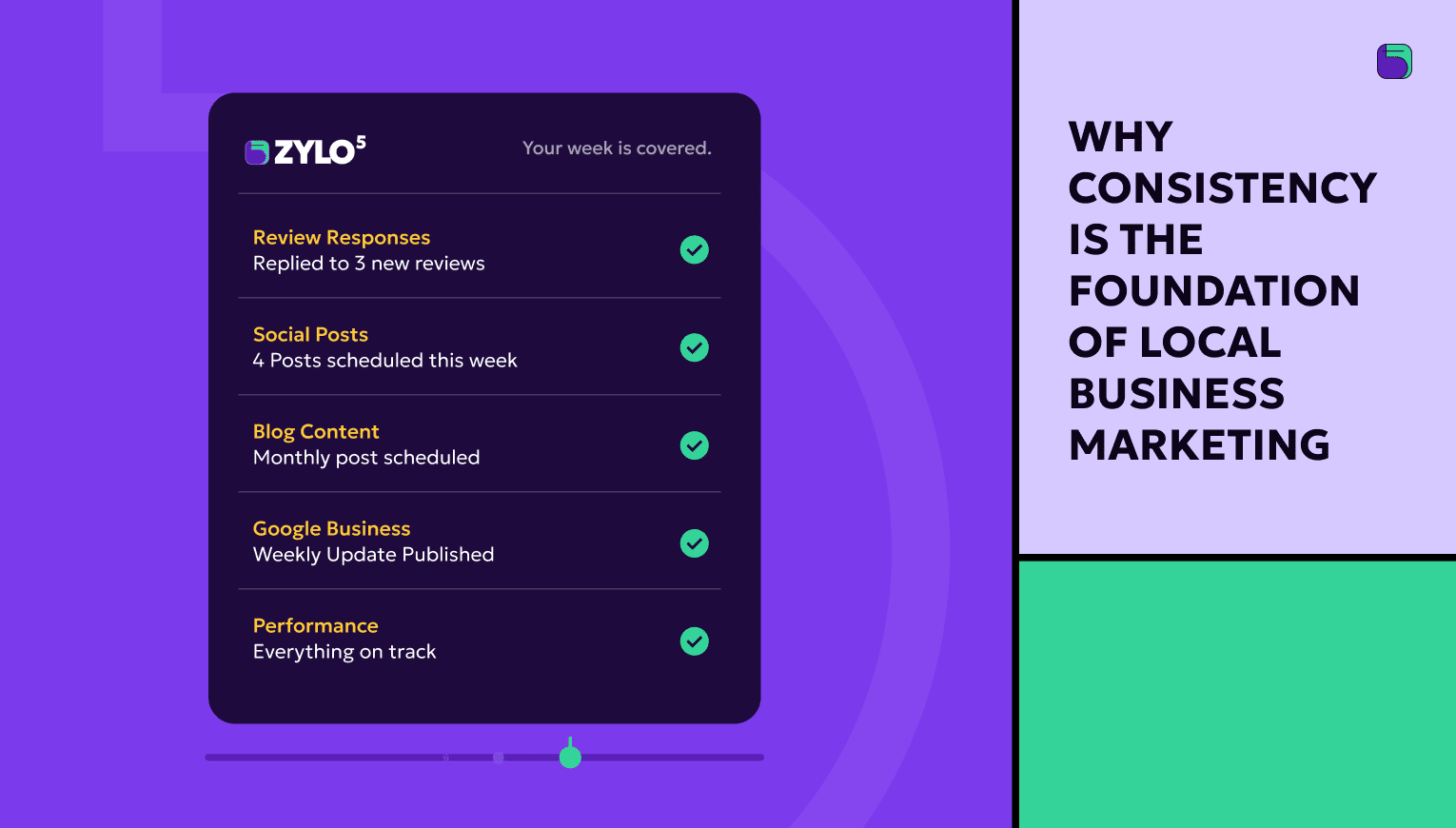
The businesses getting this right aren't doing it manually. Some have a dedicated person. Some work with an agency. And increasingly, some use a system that runs it automatically — because consistent marketing doesn't require brilliance. It requires showing up, every week, without fail.
The shift isn't about more motivation or carving out more time from an already full week. It's about building a structure so that consistent showing up happens whether or not you thought about marketing that day — your posts go out, your reviews get answered, your listing stays current, your ads keep running, every week, in your voice.
With Zylo, it starts with your URL and about five minutes to build your Brand Kit. From there, your marketing runs every week — posts, ads, review responses — for just $50 a month. If you want to see exactly what that looks like, here's how Zylo keeps your marketing running every week.