The Real Reason Your Marketing Never Gets Done

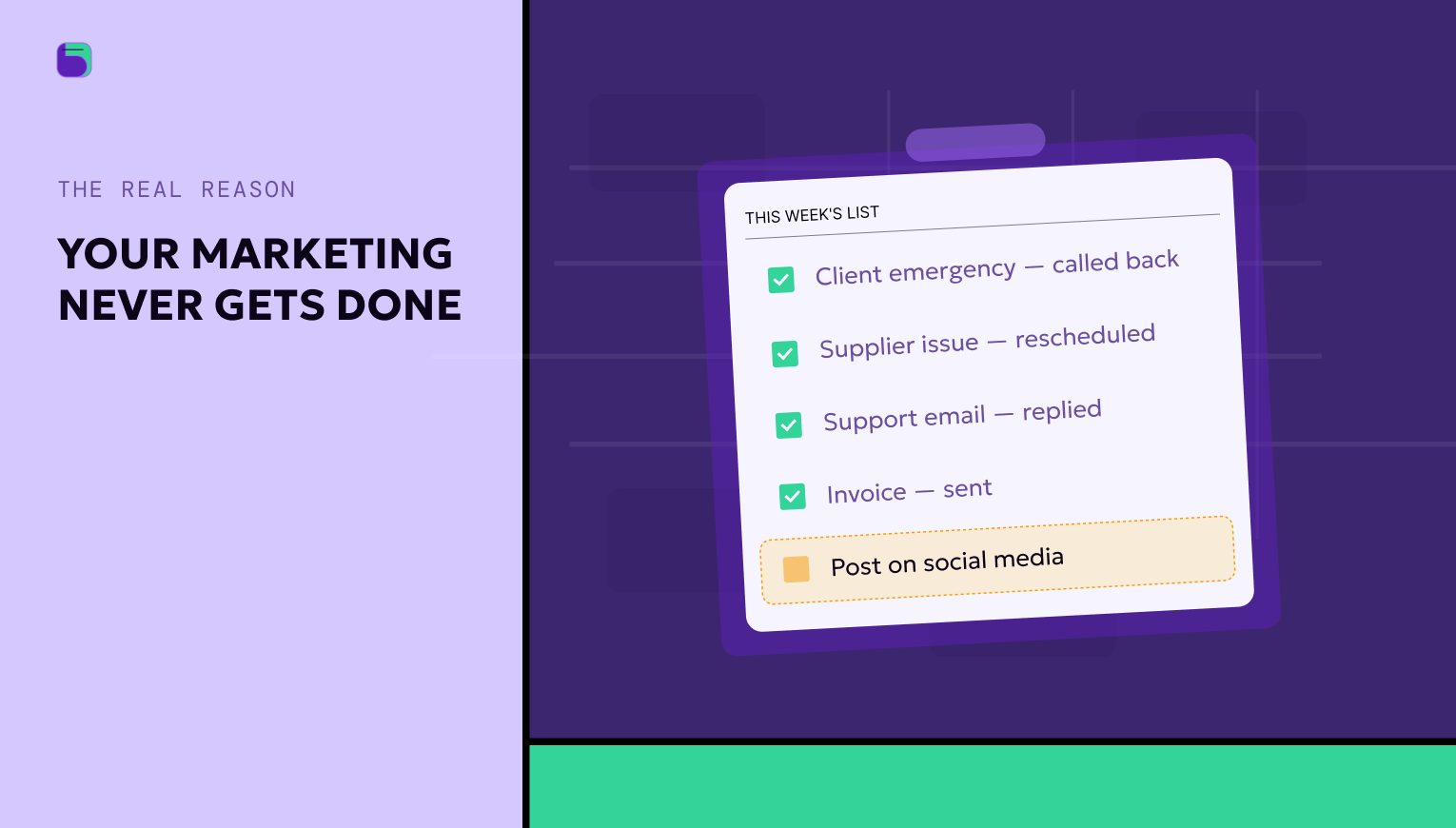


It's Sunday evening. Somewhere between thinking about Monday's first job and remembering to reorder supplies, the thought shows up again: we really need to post something this week.
Maybe a before-and-after from the kitchen remodel. Maybe that promotion that's been sitting in a notes app for three weeks. Maybe just something — because the last post was in February and the Instagram page is starting to look abandoned.
Monday comes. The first call is at 7am. By Wednesday, the post hasn't happened. By Friday, the thought has faded. It'll come back next Sunday.
This cycle doesn't break because it's not actually a discipline problem. It's a structural one.
Think about the non-negotiables like the things that must get done in your business no matter what.
When a customer calls with a leak, that gets handled immediately, because there's an obvious consequence if it doesn't. An invoice hits 30 days. That gets followed up, because cash flow is on the line. The work truck needs an oil change. That gets scheduled, because a dead truck means a dead day.
Every one of these has a built-in trigger — a moment where the cost of inaction becomes visible and unavoidable. Marketing has no trigger like that.
Skip posting this week and nothing visibly breaks. Let the Google Business Profile go stale and no alarm goes off. And it doesn't work the other direction either. Let’s break it down — a week of good marketing doesn't yield an instant, obvious uptick. No visible cost for skipping it. No visible reward for doing it. The damage is real, but it stacks up quietly over months, and by the time it's visible, it's deep.
Most marketing advice treats this like a habits issue. Block time on your calendar. Batch your content on Sundays. Use templates. Plan a month ahead.
Now, that advice isn't wrong, it just ignores the reality of how a small business actually operates. The calendar doesn't hold. Sunday is for rest or catching up on the week that ran long. The templates sit in a Canva folder, untouched after the first enthusiastic week.
See, every function that runs reliably has been given infrastructure to make it run. Invoicing has accounting software. Scheduling has a booking system. Marketing never got that infrastructure — it still runs on willpower. And willpower loses to urgency every single time.
This is why the pattern repeats. A burst of activity in January, consistent posting through February, a slow fade in March, and radio silence by April. Then the guilt cycle restarts. Not because anyone stopped caring… but because the structure was never there.
That cost, the one that doesn't show up on any given Tuesday, is real. It just operates on a different timescale than everything else in the business.
While the business is heads-down on the work, a competitor three miles away is showing up. Not with better work, just with more consistent presence. Posts going out a few times a week. Reviews getting responses within a day. A Google Business Profile that was updated this morning.
Now picture a homeowner searching "plumber near me" on their phone. Two businesses come up. One has a review reply from yesterday and a post from this week, the other has a last update from five months ago. They're not comparing quality of work, they're comparing signs of life.
The hardest part is that you never see the business you didn't get. Nobody calls to say "I found your competitor instead." It just registers as a quiet quarter, not a missed opportunity. The cause stays hidden.
But it compounds. Visibility builds on itself. Every week of consistent marketing makes the business a little more findable, a little more credible in its local market. And every quiet week gives that ground back.
If the problem is structural, the fix has to be structural too. Not another content calendar. Not another app to learn.
Here's what that looks like in practice:
It’s simple — marketing stops being the thing you have to remember to do, and becomes the thing that shows up whether you were thinking about it or not.
There's a version of running marketing for your business where it simply runs — consistently and professionally enough that the business stays visible, stays credible, and stays in front of the people searching for exactly what you offer. That frees up the hours and the mental bandwidth for the work that actually built the business in the first place. The craft, the customers, the reputation that earns referrals.
And marketing should be the thing that supports all of that — quietly, in the background, every week. It was never supposed to be another job on top of the real one.
Zylo builds a Brand Kit from your business URL and delivers a full week of marketing — posts, ads, review replies — ready to approve in about 20 minutes.
Starting at $50/month. No agency. No DIY. Just results.